Introduction:
In the face of escalating environmental concerns and the urgent need for sustainable waste management solutions, innovative technologies such as continuous tyre pyrolysis plants have emerged as promising alternatives. These plants represent a significant step towards addressing the global challenge of tyre waste while harnessing valuable resources from discarded materials. In this article, we delve into the workings of continuous tyre pyrolysis plant and explore their numerous advantages in transforming waste tyres into valuable commodities.
Understanding Continuous Tyre Pyrolysis Plants:
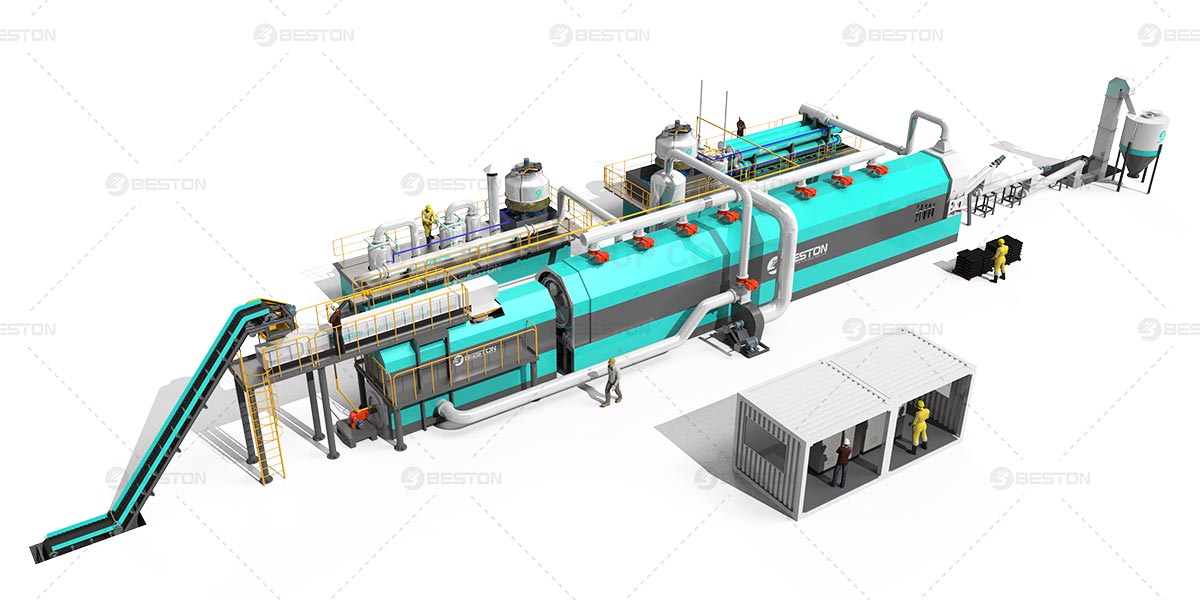
Continuous tyre pyrolysis plants are advanced facilities designed to convert waste tyres into useful products through a thermal decomposition process known as pyrolysis. Unlike traditional batch pyrolysis systems, which operate intermittently, continuous plants offer a continuous and uninterrupted process flow, enabling higher throughput and efficiency.
The Process:
The process begins with the feeding of waste tyres into a pre-treatment area, where they are shredded or chopped into smaller pieces to enhance pyrolysis efficiency. These tyre pieces are then fed into a pyrolysis reactor, where they undergo controlled heating in the absence of oxygen. This thermal decomposition leads to the breakdown of complex hydrocarbons present in tyres into simpler molecules such as pyrolysis oil, carbon black, and gases like methane and hydrogen. Get pyrolysis plant cost here.
Advantages of Continuous Tyre Pyrolysis Plants:
- High Efficiency and Throughput: Continuous tyre pyrolysis plants offer significantly higher efficiency and throughput compared to batch systems. The continuous process flow allows for uninterrupted operation, minimizing downtime and maximizing productivity. This high throughput capability enables the processing of large quantities of waste tyres, thereby contributing to effective waste management on a larger scale.
- Energy Recovery and Resource Utilization: One of the primary advantages of continuous tyre pyrolysis plants is the recovery of valuable resources from waste tyres. Pyrolysis oil obtained from the process can be utilized as a fuel source for various industrial applications or further refined into high-quality fuels like diesel or gasoline. Carbon black, another byproduct of pyrolysis, can be used as a reinforcing agent in rubber and plastic manufacturing or as a pigment in ink and paint industries. Additionally, the gases produced during pyrolysis can be utilized to generate heat or electricity, further enhancing the energy recovery potential of the process.
- Environmental Sustainability: Continuous tyre pyrolysis plants contribute to environmental sustainability by diverting waste tyres from landfills and illegal dumping sites, thereby reducing soil and water pollution. The conversion of waste tyres into valuable products through pyrolysis also helps mitigate the environmental impact associated with conventional disposal methods such as incineration or landfilling. Furthermore, the utilization of pyrolysis oil and gases as alternative fuel sources can reduce reliance on fossil fuels, leading to lower greenhouse gas emissions and mitigating climate change. Compare the small pyrolysis machine here.
- Versatility and Adaptability: Continuous tyre pyrolysis plants are versatile in their ability to process various types of waste tyres, including passenger car tyres, truck tyres, and even industrial tyres. This versatility allows for the efficient utilization of diverse tyre waste streams, regardless of size or composition. Moreover, continuous plants can be adapted to accommodate changes in feedstock characteristics or processing requirements, ensuring operational flexibility and optimization.
Conclusion:
Continuous tyre pyrolysis plants represent a significant advancement in waste-to-resource technology, offering numerous advantages in terms of efficiency, resource utilization, environmental sustainability, and versatility. By harnessing the potential of thermal decomposition, these plants enable the transformation of waste tyres into valuable commodities while mitigating environmental pollution and contributing to a circular economy. As the demand for sustainable waste management solutions continues to rise, continuous tyre pyrolysis plants stand poised to play a pivotal role in revolutionizing the way we manage and utilize waste tyres. More information about Beston Group here.